The 42 times world champion Bjørn Dunkerbeck opens his bag of tricks for all DAILY DOSE readers and reveals how even amateurs can become really fast.
They were (and still are) a team that can hardly be beaten: While Bjørn Dunkerbeck scored successes on the regatta track, Victor Couto kept the world champion's back free in terms of organization and made sure that the equipment was prepared perfectly.
Now the team, which has been completed by Victor's wife Anne Schindler since many years, is mainly focused on getting as many people as possible on the water and, among other things, organizes decentralized GPS races in which amateurs and professionals can compete. We describe at the end of the article how everyone can participate in one of Bjørn's events.
But first of all, let's talk about the riding technique and the equipment: With almost any kind of planing boards, you can improve your own speed technique and learn the basics. In principle, you first ride against yourself and get to know your equipment optimally.
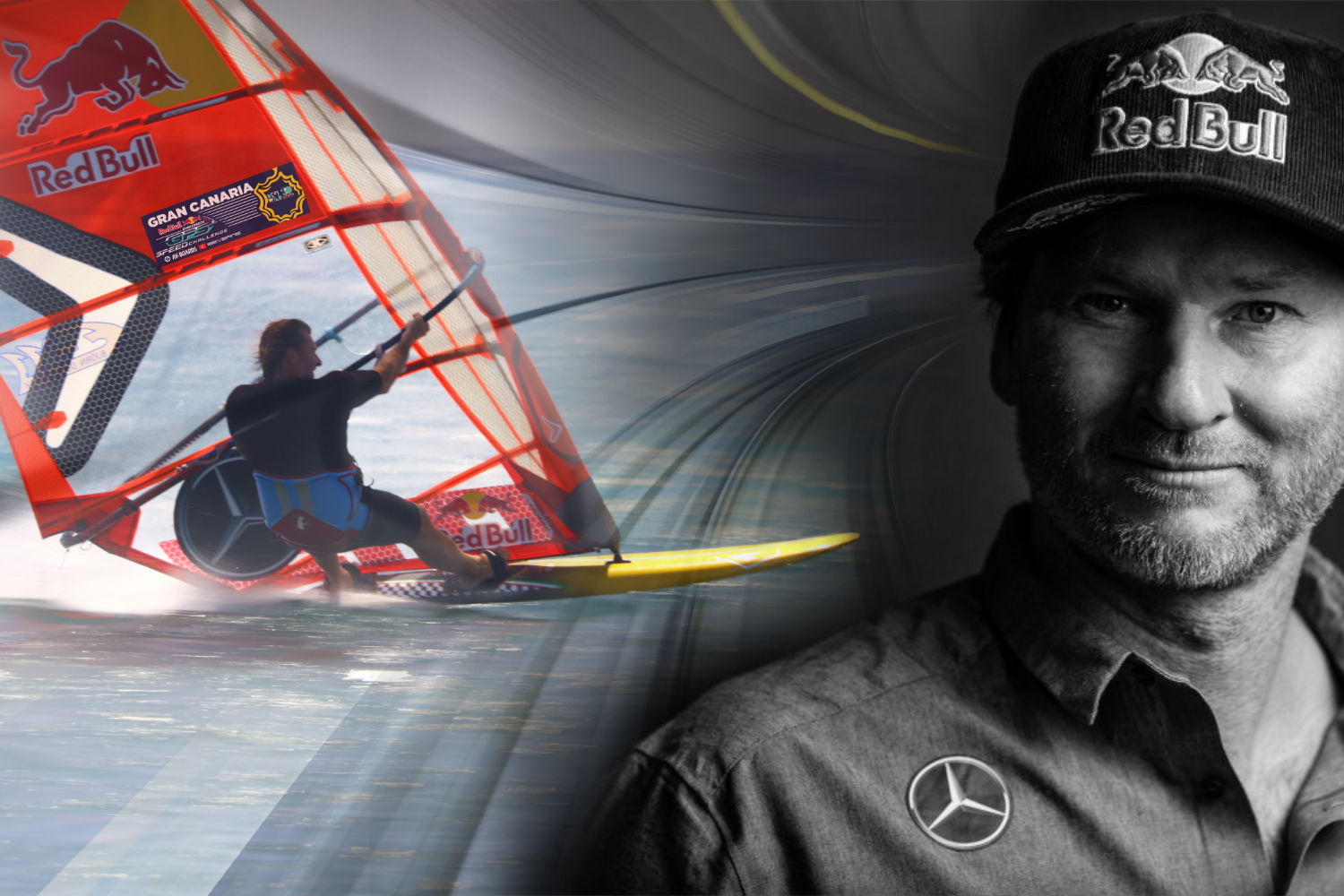
Bjørn did not achieve his 42 World Championship titles by chance.
The most successful professional athlete of all times knows exactly how to ride fast.
The most successful professional athlete of all times knows exactly how to ride fast.
Windsurfing speed riding technique
Tips from Bjørn Dunkerbeck

On the beach, the boom (without the mast foot) is at about chest height. The ends of the harness lines are relatively far apart from each other.
"The most important tool is not the rubber hammer, but the GPS."
What is meant by this is that only the GPS, whether as an app on the Smartwatch or Smartphone or as a dedicated GPS tracker, can provide information about how successful the setup really is. This is the only way to measure if a modification just feels faster or if it really is. "Often a fast run feels slower than a slower run on choppy water, for example. This is because an impending loss of control or a disturbing choppy wave is what we perceive as perceived speed," explains Bjørn. Therefore, you should trust your GPS and not your gut feeling.
"Only ever change one setting on your board or rig at a time."
If you change settings, you should never change more than one parameter at a time, so that the parameter change is clearly understandable. It's best to write down the changes and keep a kind of diary in which the wind force and the conditions of the spot are also recorded.
"Always change only a little."
There is no point in adjusting the mast foot by several centimeters, for example. The changes should be made in small steps. These steps should be documented (e.g. by markings) so that you know later what and how much you have changed.
Remember: "Only after you have ridden the same speed five times over 10 seconds, you should change something again."
What is meant by this is that only the GPS, whether as an app on the Smartwatch or Smartphone or as a dedicated GPS tracker, can provide information about how successful the setup really is. This is the only way to measure if a modification just feels faster or if it really is. "Often a fast run feels slower than a slower run on choppy water, for example. This is because an impending loss of control or a disturbing choppy wave is what we perceive as perceived speed," explains Bjørn. Therefore, you should trust your GPS and not your gut feeling.
"Only ever change one setting on your board or rig at a time."
If you change settings, you should never change more than one parameter at a time, so that the parameter change is clearly understandable. It's best to write down the changes and keep a kind of diary in which the wind force and the conditions of the spot are also recorded.
"Always change only a little."
There is no point in adjusting the mast foot by several centimeters, for example. The changes should be made in small steps. These steps should be documented (e.g. by markings) so that you know later what and how much you have changed.
Remember: "Only after you have ridden the same speed five times over 10 seconds, you should change something again."
Anzeige

A perfectly balanced rig does not only help during speed runs. Proper trim and optimally adjusted components make windsurfing easier.
The rig
Assemble your rig according to the manufacturer's instructions. The manufacturers have invested a lot of time to establish the basic settings. Based on this, if you are overpowered and can't switch to a smaller sail, you can trim in a bit more loose leech and give a bit more tension to the clew. In principle, it is better to change the sail size than to trim in more loose leech. Also, on a half-wind course it is better to have less loose leech than on a downwind course.
Speed is sailed on a downwind course and the pros even use spacers between the cambers (profile tongs that support the battens on the mast) and the battens to make the profile even stiffer and more curved. The profile is not flattened for speed.
The boom height
Björn likes to ride the boom at shoulder height. His arms are as horizontal as possible in relation to the boom. If you experience control problems when sailing, for example in choppy conditions, you can try to lower the boom a bit. If you want to get more power out of the sail, you can raise the boom a bit. In general Bjørn rides the boom further up with big boards and little wind and further down with a small board and a lot of wind.
The position of the mast foot
The mast foot should initially be mounted according to the manufacturer's instructions. Starting from that, one can then vary. When the board starts to fly, the mast foot can be pushed forward a little bit. If the board seems to stick on the water, the mast foot should be taken back a little bit.
The harness
For Bjørn, the seat harness is still the benchmark for speed in order to bring as much tension and power as possible onto the board. Nevertheless, you can still use a waist harness, for example, if you value freedom of movement more than gaining control.
The harness lines
"The harness lines are the most personal thing on the whole rig," says Bjørn. You often see competitors who have fitted the harness lines extremely close together. How you use the lines is a matter of taste, but Bjørn advises not to ride the lines too tight, because tight installation also means less control. Bjørn himself mounts the lines relatively wide apart.
The fins
Use the smallest fin possible. With this you go the fastest. Carbon fins have been in fashion for a few years. Bjørn rides Carbon fins about 2 cm shorter than in G10.
The ratio of fin to sail size
Bjørn uses the following combinations. But you have to know that he rides very overpowered and of course has excellent board control:
The board
Slalom boards are ideal for speed beginners. But of course everybody can use his everyday board, no matter if it is a wave or freeride board, to work on his or her speed. The most important thing is that you make progress by riding your own material. But you have to understand that your equipment has limits. Real top speeds can only be reached with special boards.
The body tension
Move as little as possible during the speed run, your body should be completely under tension. You must try to "lock in" in your speed position. Whoever is jiggling around becomes slow.
The line
After each run, Bjørn looks back to see if his line was straight based on the trace of spray. The direct line from A to B guarantees the best speed in both GPS measurement and conventional speed competitions. Anyone who curves around loses time.
The spot
You should know the spot very well, and you should familiarize yourself with your spot in advance. An example: tides produce currents, which in turn affect the speed. Also wind covers (e.g. trees) or areas with more choppy waves will slow you down. If you are looking for maximum speed and take part in GPS speed sessions, you can have a considerable influence on speed by carefully selecting your own speed strip.
Tip for women
The German record holder Anne Schindler says: "Trust in your ability and feeling when choosing your equipment. Men often suggest smaller sail sizes because they can't imagine that you might sail the same size or more than them.
Assemble your rig according to the manufacturer's instructions. The manufacturers have invested a lot of time to establish the basic settings. Based on this, if you are overpowered and can't switch to a smaller sail, you can trim in a bit more loose leech and give a bit more tension to the clew. In principle, it is better to change the sail size than to trim in more loose leech. Also, on a half-wind course it is better to have less loose leech than on a downwind course.
Speed is sailed on a downwind course and the pros even use spacers between the cambers (profile tongs that support the battens on the mast) and the battens to make the profile even stiffer and more curved. The profile is not flattened for speed.
The boom height
Björn likes to ride the boom at shoulder height. His arms are as horizontal as possible in relation to the boom. If you experience control problems when sailing, for example in choppy conditions, you can try to lower the boom a bit. If you want to get more power out of the sail, you can raise the boom a bit. In general Bjørn rides the boom further up with big boards and little wind and further down with a small board and a lot of wind.
The position of the mast foot
The mast foot should initially be mounted according to the manufacturer's instructions. Starting from that, one can then vary. When the board starts to fly, the mast foot can be pushed forward a little bit. If the board seems to stick on the water, the mast foot should be taken back a little bit.
The harness
For Bjørn, the seat harness is still the benchmark for speed in order to bring as much tension and power as possible onto the board. Nevertheless, you can still use a waist harness, for example, if you value freedom of movement more than gaining control.
The harness lines
"The harness lines are the most personal thing on the whole rig," says Bjørn. You often see competitors who have fitted the harness lines extremely close together. How you use the lines is a matter of taste, but Bjørn advises not to ride the lines too tight, because tight installation also means less control. Bjørn himself mounts the lines relatively wide apart.
The fins
Use the smallest fin possible. With this you go the fastest. Carbon fins have been in fashion for a few years. Bjørn rides Carbon fins about 2 cm shorter than in G10.
The ratio of fin to sail size
Bjørn uses the following combinations. But you have to know that he rides very overpowered and of course has excellent board control:
- sail: 9.4 - fin: 46 to 50 cm
- sail: 8.6 - fin: 40 to 46 cm
- sail: 7,8 - fin: 36 to 40 cm
- sail: 7.0 - fin: 30 to 36 cm
- sail: 6.2 - fin: 28 to 34 cm
- sail: 5.5 - fin: 20 to 26 cm
- sail: 5.2 and 5.0 - fin: 18 cm to 28 cm
The board
Slalom boards are ideal for speed beginners. But of course everybody can use his everyday board, no matter if it is a wave or freeride board, to work on his or her speed. The most important thing is that you make progress by riding your own material. But you have to understand that your equipment has limits. Real top speeds can only be reached with special boards.
The body tension
Move as little as possible during the speed run, your body should be completely under tension. You must try to "lock in" in your speed position. Whoever is jiggling around becomes slow.
The line
After each run, Bjørn looks back to see if his line was straight based on the trace of spray. The direct line from A to B guarantees the best speed in both GPS measurement and conventional speed competitions. Anyone who curves around loses time.
The spot
You should know the spot very well, and you should familiarize yourself with your spot in advance. An example: tides produce currents, which in turn affect the speed. Also wind covers (e.g. trees) or areas with more choppy waves will slow you down. If you are looking for maximum speed and take part in GPS speed sessions, you can have a considerable influence on speed by carefully selecting your own speed strip.
Tip for women
The German record holder Anne Schindler says: "Trust in your ability and feeling when choosing your equipment. Men often suggest smaller sail sizes because they can't imagine that you might sail the same size or more than them.
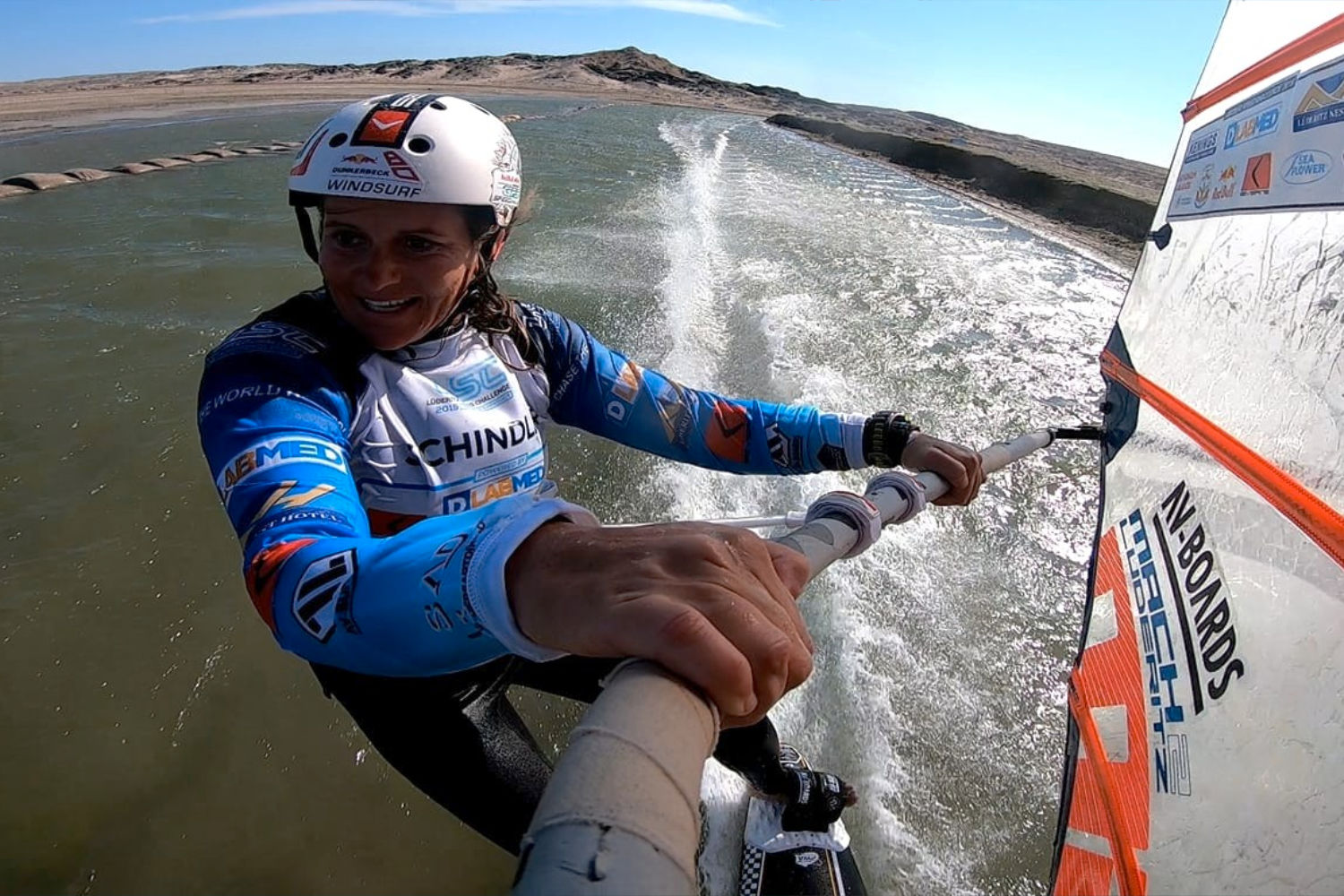
Anne Schindler hält den Deutschen Rekord im Speedsurfen. Hier ist sie auf dem Speedkanal in Namibia unterwegs.
Participation in the race
Björn's Dunkerbeck Speed Challenge, for example, will run until 1.12.2020. There are many prizes to win and participation is free of charge. Professionals are also taking part, but amateurs and novices are very welcome. The same competition is also available for foilsurfers (www.gps-foilsurfing.com) and Bjørn is already planning three GPS speed events for next year.
To participate, you first have to register on gps-speedsurfing.com. To put it simply, your speeds are calculated from uploaded GPS tracks by the server. From these tracks the server will choose the fastest tracks of your runs. It is important that your runs are at least 250 meters long.
For a start any kind of GPS tracker that can write a GPX file is sufficient. This is basically any smartphone (with the appropriate app) but also Smartwatches can write these tracking files. For front placements only professional trackers, like those from Locosys are accepted.
Also from Apple Watch the GPX tracks can be exported via a trick without an additional app, if the session was recorded by the standard installed Fitness App. (Open Health App, click on the user icon in the upper right corner, then select Export all health data. This will export the GPX tracks to the workout-routes folder).
Björn's Dunkerbeck Speed Challenge, for example, will run until 1.12.2020. There are many prizes to win and participation is free of charge. Professionals are also taking part, but amateurs and novices are very welcome. The same competition is also available for foilsurfers (www.gps-foilsurfing.com) and Bjørn is already planning three GPS speed events for next year.
To participate, you first have to register on gps-speedsurfing.com. To put it simply, your speeds are calculated from uploaded GPS tracks by the server. From these tracks the server will choose the fastest tracks of your runs. It is important that your runs are at least 250 meters long.
For a start any kind of GPS tracker that can write a GPX file is sufficient. This is basically any smartphone (with the appropriate app) but also Smartwatches can write these tracking files. For front placements only professional trackers, like those from Locosys are accepted.
Also from Apple Watch the GPX tracks can be exported via a trick without an additional app, if the session was recorded by the standard installed Fitness App. (Open Health App, click on the user icon in the upper right corner, then select Export all health data. This will export the GPX tracks to the workout-routes folder).